Salerio: Defeating the Clock in Post-Trade Processing – Your Imperative Solution in the Age of T+1 Settlement

Defeating the Clock in Post-Trade Processing

In the relentless race against time in the operational world of asset management, the ticking clock of the T+1 trade processing arrival can be your greatest adversary. The post-trade processing landscape is evolving, and the consequences of falling behind are dire. In the business-critical environment, Salerio emerges as the indispensable guardian of your firm’s efficiency and success. Without it, the cost of lagging behind is a haunting reality.

The Threat of the ‘T+1 Arrival’: A Race Against Time
Shifts towards more T+1 settlement cycles are reshaping the fabric of post-trade processing. The demands for speed, accuracy, and compliance have never been higher. Asset management firms find themselves at a crossroads, where manual processes and outdated systems are becoming obsolete relics in the face of a ticking clock.

“Automate for Acceleration” – Automation for faster and error-free post-trade processes.

The consequences of missing T+1 deadlines are severe, ranging from financial penalties to reputational damage that can harm a firm’s standing in the industry. Falling behind is a palpable concern, and without a solution like Salerio, the risks are significant.

Salerio: Your Unassailable Fortress in the T+1 Era
Salerio is not just a solution; it is the imperative answer to the challenges posed by the arrival T+1 in several trading regions, with more to come. This cutting-edge software system is engineered to automate and streamline post-trade processing, ensuring that your firm not only meets but surpasses the demands of the accelerated settlement cycles.

Automated Efficiency:
Salerio eliminates the shackles of manual processing, ushering in an era of unparalleled efficiency. It automates complex post-trade workflows, reducing the risk of errors and ensuring that your firm operates at the speed imposed by T+1 trading. No longer will you be tethered to time-consuming, error-prone processes that put your firm’s operational costs on the line.

Real-Time Visibility:
In the T+1 era, information is power. Salerio provides real-time visibility into post-trade activities, enabling your firm to make informed decisions swiftly. With a comprehensive overview at your fingertips, you can navigate the complexities of post-trade processing with confidence; never being blindsided by unforeseen challenges.

The Reality for Those Without Salerio
For those without Salerio, T+1 is fraught with problems. Picture a scenario where every second counts, and the absence of automation leaves your firm mired in the inefficiencies of outdated processes. The fear of missing T+1 deadlines, of incurring financial penalties, and tarnishing your firm’s reputation becomes a real issue for concern.

In the fast-evolving landscape of post-trade processing, the time for complacency is over. Salerio is your shield against the impending storm. Don’t let the ticking clock dictate your fate – embrace the transformative power of Salerio and be a frontrunner in the race against time. The future of post-trade processing belongs to those who embrace innovation – make Salerio your ally in conquering the operational challenges of the changing T+1 era.

If you would like to discuss any of the points raised here, please contact us at resources@corfinancialgroup.com or click here to learn more about corfinancial’s post-trade settlement solutions, Salerio and SureVu.


Are your trade processing systems fit for purpose?

Not fit for purpose showing an ice cream cone

David Veal, Senior Executive at corfinancial®, outlines why trade processing systems in the buy-side arena may no longer be fit for purpose.

Wealth Management

The T+1 settlement cycle is due to be instigated in May 2024, and efficient trade processing systems are critical for the smooth operation of any financial institution. However, when such systems fail to address demands for accurate, efficient, and fast-paced processing, it can have far-reaching consequences for an organisation. This article dissects key factors that can lead to the failure of a trade processing system being fit for purpose, with a focus on common technical and operational issues. 

Root causes of problems with dated trade processing systems

Technical issues
Inadequate infrastructure:
 one of the primary technical issues that contribute to the failure of such systems is outdated and inadequate infrastructure – Dated systems often struggle to handle an increasing volume of trades, leading to performance bottlenecks and frequent outages.

Integration challenges: the lack of integration with other critical systems, further exacerbates technical shortcomings – This results in a disjointed workflow and hinders real-time decision-making.

Scalability problems: many in-house systems can fail to scale effectively with the growing demands of the business. As a result, increasing numbers of trades lead to delays, inaccuracies, and ultimately economic and reputational costs from failed trades.

Operational issues
Inefficient processes:
 poor or manually orientated operational processes play a significant role in the failure of many trade processing systems. Manual data entry, redundant workflows, and a lack of automation lead to errors, delays, and increased operational costs.

Inadequate training or intuitive functions: lead to suboptimal utilisation of a system’s capabilities and an increased risk of errors.

Insufficient monitoring and alerts: the absence of robust and timely alerts means that potential issues are not identified and addressed in a proactive manner. A reactive rather than proactive approach further exacerbates the impact of operational challenges.

Needing more people: reducing operating windows, where exception management is not maximised, results in a need for ‘more hands on deck’, in order to beat the clock. Changing working hours for operational staff can be challenging and costly.

Implementing changes
Organisations need robust solutions to address the technical, operational, and procedural challenges that lead to failures associated with ineffective systems. Two prominent platforms that have demonstrated effectiveness, governance, and controls in trade processing management are Salerio and SureVu from corfinancial.

Salerio is a trade management platform known for its ability to streamline trade processing operations and enhance efficiency, addressing technical issues that plague trade processing systems.

Here is how Salerio can serve as a solution:

  1. Scalable infrastructure: designed to handle high volumes of trades, ensuring that the system can adapt to the evolving needs of the business without compromising performance.
  2. Seamless integration: Salerio offers seamless integration with other critical systems, including OMS and position-keeping platforms. This integration fosters a cohesive workflow, enabling real-time decision-making and reducing the risk of disjointed operations.
  3. Automation and workflow optimisation: by automating manual processes and optimising workflows, Salerio minimises errors and delays associated with inefficient operational procedures, leading to increased operational efficiency and reduced costs.

SureVu is a failed trade management solution designed to enhance an organisation’s adherence to industry standards and regulations. In the wake of the new Settlement Discipline Regime (‘SDR’) introduced by the CSDR, SureVu plays a pivotal role in failed trade avoidance, rather than failed trade management activities still adopted by many firms.

SureVu provides governance to reduce the risk of settlement discrepancies. Its intuitive interface empowers users to avoid settlement failure rather than manage it, enabling high levels of STP.

Solving the problems
By integrating Salerio or SureVu into the operational framework, organisations can easily address the root causes of previous system failures.

Salerio’s technology addresses trade matching and processing issues, while SureVu helps firms avoid settlement failure as opposed to managing it after the fact. As part of a core middle office solution, these systems provide a comprehensive approach to trade management, fostering a resilient trade processing operation for sustainable growth when replacing dated solutions.

Salerio and SureVu resolve operational headaches and fears of a costly operational team that are destined to be a reality in the second half of 2024 cost-effectively and comprehensively. Salerio and SureVu do it well… and that includes the price.

If you would like to discuss any of the points raised here, please contact us at resources@corfinancialgroup.com or click here to learn more about corfinancial’s post-trade settlement solutions, Salerio and SureVu.

T+1 settlement – The imperative for automated solutions in the securities market

T+1 global transactions

By Samil Aslam, Research Analyst at corfinancial®

Efficient settlement processes are crucial to the smooth functioning of the securities market. The introduction of T+1 settlement, where trades are settled one business day after the transaction, has gained significant attention in recent months. This shift from the T+2 settlement lifecycle has presented both opportunities and challenges for market participants. To navigate these complexities and streamline operations, automation has become essential. In this article, we delve into the impact of T+1 settlement and highlight the need for automated solutions, regardless of the global region introducing the change. 

The significance of T+1 settlement
T+1 settlement has brought about several advantages that contribute to a more efficient market. By reducing the settlement period, it minimises counterparty risk and provides quicker access to funds, enhancing liquidity. It also reduces the need for participants to tie up capital for an extended period, allowing them to deploy it more effectively. Additionally, shorter settlement cycles reduce market participants’ exposure to potential market risks, resulting in a more stable and secure trading environment.

Data and statistics have consistently shown that shorter settlement periods, such as T+1, can significantly impact market volatility. Studies indicate that shorter settlement cycles can reduce the scope for speculation and market manipulation, thereby enhancing market integrity and increasing market efficiency.

With the implementation of T+1 settlement, market participants face the challenge of adapting to a faster-paced settlement process. Manual settlement procedures that rely on cumbersome paperwork, manual reconciliation, and communication between various parties are increasingly becoming inefficient and error-prone. To address these challenges, automation is essential.

Settlement failure and non-compliance with the settlement discipline regime can harm an asset management firm’s reputation. These incidents may be perceived as a lack of operational robustness or failure to meet regulatory requirements. Negative publicity could result in a loss of client trust, potential outflows of assets under management, and damage to long-term business relationships.

Increased operational complexity and costs
The settlement discipline regime introduces new requirements and procedures, such as mandatory cash penalties and transaction reporting obligations. Asset management firms need to adapt their existing processes and systems to ensure compliance, which often involves significant operational changes. The additional complexities can strain internal resources and require substantial investments in technology and infrastructure.

Asset management firms may also face increased operational costs due to potential penalties for settlement fails. The additional expenses associated with compliance can impact profitability and potentially lead to higher fees for investors.

The move to T+1 is undoubtedly a step forward for the industry, but key questions remain for middle office or operational teams:

  • Will your operational practices easily adapt to the pressures of T+1 deadlines?
  • Does your trade processing technology enable you to proactively avoid trades from failing?
  • Is your platform scalable enough to adapt to the demands of same-day processing activities?
  • Are you prepared for custodians to change their Service Level Agreements?
  • Are you prepared for your operating day to be extended?

Salerio and SureVu: automated solutions for efficient settlement
Salerio and SureVu are cutting-edge technologies that streamline the settlement process, reducing risks and increasing operational efficiency. Salerio is an automated post-trade management solution that ensures timely and accurate reconciliation of trades, automating the matching of trades across multiple platforms. By eliminating manual intervention, Salerio reduces settlement failures and minimises the risk of trade discrepancies.

SureVu, on the other hand, is an advanced tool that provides real-time insights into the settlement process. It leverages data to monitor trade statuses and proactively identifies settlement issues. With SureVu, market participants gain comprehensive visibility into their trades, enabling timely interventions and minimising settlement failures.

Automation eliminates manual errors and reduces the time spent on manual reconciliation, freeing up resources for more strategic tasks.

All of which address the bullet point questions raised above.

Conclusion
The introduction of T+1 settlement has ushered in a new era of efficiency and reduced risk in the securities market. However, to fully harness the benefits of shorter settlement cycles, market participants must embrace automation. Solutions like Salerio and SureVu offer the necessary tools to streamline post-trade processes, minimise settlement failures, and enhance overall operational efficiency. By leveraging automation, market participants can navigate the complexities of T+1 settlement with confidence, fostering a more robust and secure securities market for all stakeholders. Automation eliminates manual errors and reduces the time spent on manual reconciliation, freeing up resources for more strategic tasks.

If you would like to discuss any of the points raised here, please contact us at resources@corfinancialgroup.com or click here to learn more about corfinancial’s post-trade settlement solutions, Salerio and SureVu.

Salerio trade processing goes live at Jennison Associates

Jennison Associates + Salerio

New York, March 14, 2023 – corfinancial®, a leading provider of specialist software to the financial services sector, announces that New York-based investment manager Jennison Associates (Jennison) has implemented Salerio, their post-execution trade processing, matching, confirmation and settlement instruction management system.

Salerio’s centralized trade processing management enabled Jennison to retire several inefficient and expensive-to-maintain legacy systems. This provided major gains in data accuracy and real-time management of executed trades earlier in the middle office trade management process.

Jason Minkler, Managing Director and Head of Operations at Jennison Associates, said: “Salerio provides exception management workflows across multiple asset classes via a centralized dashboard which has significantly improved our middle-office processes. We are now able to automate trade workflows and reduce operational risk. The software delivers the mission critical capabilities and governance needed to get ahead of issues.”

Minkler adds: “The Jennison team and corfinancial worked very well together, forming a strong partnership that gave us a solid knowledge base before going live with equities in December. Additional asset classes are scheduled to go live throughout 2023. Furthermore, Salerio supports Jennison’s global trading model, with corfinancial providing round-the-clock support.”

David Veal, Senior Executive – Client Solutions at corfinancial, said: “Our post-trade processing solution is intuitive, making it easy for clients like Jennison Associates to migrate away from legacy systems with confidence. Working in partnership with Jennison, we have enhanced Salerio, which will benefit firms preparing for T+1.”

Founded in 1969, Jennison Associates manages $164 billion of client assets (as of December 31, 2022) in a range of equity and fixed income investment strategies. Jennison’s investing approach is rooted in its fundamental research and security selection; all portfolios are built from the bottom-up, security by security, and its internal research underlies all investment decisions.

For more information on the salerio solution, contact corfinancial at info@corfinancialgroup.com.

Archer turns to Salerio to add retail trade processing

Archer logo

Boston, May 3, 2022 – corfinancial®, a leading provider of specialist software and services to the financial services sector, announces that Archer, a leading technology enabled service provider for investment managers, has extended their use of corfinancial’s  Salerio® Post-Trade Execution solution to commence trade processing for their retail services.

Headquartered in the Philadelphia region, Archer provides a robust ecosystem of technology and services to the asset management industry. An early adopter of Robotic Processing Automation, Archer continues to deploy advanced technology like Salerio to streamline processes for investment manager clients and their brokers.

“As more investment managers launch new products specifically for retail investors, we’re continuing to invest in technology that creates powerful operational efficiencies for our clients,” said Bob Lage, EVP, Global Head of Product and Technology at Archer. “At Archer, we’re always looking to upgrade our tools in ways that allow our clients to grow their businesses. By integrating Salerio into our trade settlement process, we are adding automation that creates significant efficiencies in matching trades across our clients’ counterparties.”

Archer used Salerio to migrate its institutional clients away from DTCC’s OASYSTM utility in December 2021 and began moving its retail clients in March 2022. This latest move with the retail application of the technology enables asset managers to match trades more rapidly through a centralized service. Specifically, Salerio facilitates enhanced connectivity to banks and brokers via DTCC’s CTMTM utility, including SWIFT messaging – all highly automated and fully integrated into the Archer IBOR, dashboards and reporting.

David Veal, Senior Executive for Client Solutions at corfinancial added: “Archer’s confidence in our Salerio solution is well-received and this recent change reflects the flexibility of our product to adapt to different operational processes, creating a comprehensive, centralized solution that can scale as our clients’ businesses grow.”

SureVu – CSDR introduction – gaining competitive edge

CSDR Trade Settlement

Lower risk, higher efficiency: gaining competitive edge in CSDR trade settlement.

The Central Securities Depositories Regulation (CSDR) has been in force since September 2014 and introduces regulatory change on a regular basis. There are a number of rules and industry changes being introduced in the near future by the CSDR, one of which is the new Settlement Discipline Regime (SDR), expected to come into force on 1 February 2022. It introduces several major changes to the settlement of financial instruments that will have a major impact on all market participants, not least the operations of buy- and sell-side firms.

corfinancial: Salerio software ready for OASYS decommissioning

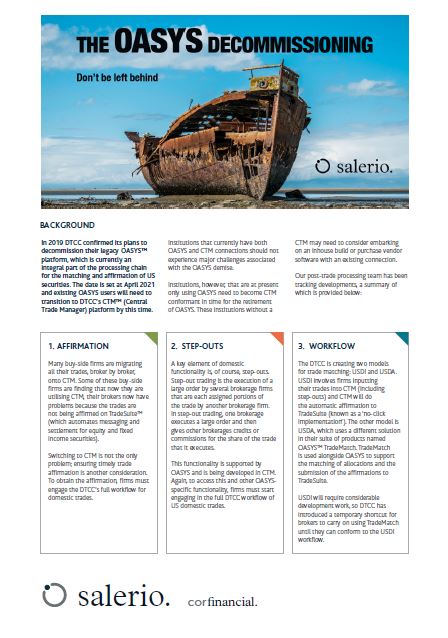
December 2020 - corfinancial, a leading provider of specialist software and services to the financial services sector, announces today that its Salerio post-trade system is now fully tested and ready to assist firms in the migration away from DTCC’s legacy OASYS™ platform.

The Depository Trust & Clearing Corporation (DTCC) is a post-trade financial services company providing clearing and settlement services to the financial markets. The firm has confirmed plans to decommission its OASYS™ solution by October 2021, resulting in the compulsory migration of users to its CTM™ processing model in order to continue the automated processing of US domestic trades.

DTCC recently announced that a small number of financial services technology providers have agreed to certify their interfaces in support of enhanced US trade flow capabilities in DTCC’s CTM™ service. Salerio is now a certified solution to facilitate the transition away from OASYS, having successfully completed its conformance testing with DTCC.

David Veal, Senior Executive, Client Solutions, corfinancial: “Working as an early adopter partner with DTCC throughout the second half of this year ensured that we were well prepared for the modifications that they were applying to their CTM utility. Salerio has been updated with the OASYS parity functionality. Our solution is quick to implement, due to our standard model approach, fully functional CTM connectivity and workflow,” added Veal. “Salerio clients that require this functionality ahead of the October 2021 deadline are good to go.”

Baillie Gifford migrates the processing of its futures transactions to corfinancial’s post-trade system, salerio

London, 27 July 2020 – corfinancial, a leading provider of specialist software and services to the financial services sector, reports that Edinburgh-based investment manager Baillie Gifford has migrated the processing of its futures transactions to corfinancial’s post-trade system, Salerio.

Baillie Gifford selected Salerio in 2018 after a review of its proprietary trade matching and settlement practices. The firm decided that it was time to transition its existing operating model to a strategic solution that encompassed the entire trade processing lifecycle. Not only was it looking for a comprehensive, automated exception management system, but also the right people to work with.

Initially, Salerio was used for Baillie Gifford’s equity and bond trading, but since April 2020 futures transactions have been added to the asset class mix.

“The fact that we went live on futures during lockdown bears testimony to the robust nature of the Salerio application and the flexibility of corfinancial’s implementation team,” said Louise Laidlaw, Head of Settlements, Baillie Gifford. “We ran Salerio in parallel with our legacy futures application until we were ready to switch the old system off. Ultimately we had a flawless transition.”

One key benefit for Baillie Gifford of utilising Salerio for futures trades has been the replacement of faxed trade notifications (a requirement from one of its custodians) with more streamlined SWIFT instructions. In a working from home environment, this manual handling proved to be particularly challenging before Salerio came onstream.

“Bringing futures into scope with Salerio has eliminated some time-consuming, manual processing for us,” said Laidlaw. “Moreover, the transition has improved our control, authorisation and visibility of trade matching and settlement for futures transactions.”

Remote working during market turmoil has not affected our clients using Salerio

London, 22 June 2020 - corfinancial, a leading provider of specialist software and services to the financial services sector, reports that its clients have enjoyed uninterrupted trade matching and settlement during lockdown – even when trading volumes suddenly spiked.


One example is that of leading investment management company Baillie Gifford. The Edinburgh-based firm was using proprietary post-trade processing systems before choosing Salerio in 2018 and they believe that their smooth transition to remote working conditions, without any interruption to the service they provided to their investors, was testament to the software they had installed from corfinancial.

In March we experienced a huge increase in equity, bond and FX trades. For example, our bond trading volumes more than doubled from the previous month and over a seven-day period we had more than 500 bond trades alone. In April, our bond trading volumes went up even further, by almost another 50 percent,” said Louise Laidlaw, Head of Settlements, Baillie Gifford. “It didn’t matter how many trades came through; we knew we had the ability to cope using Salerio. Working remotely, even with these exceptional trading volumes, has had no impact on our operations whatsoever. The transition to home working was seamless and this theme came across strongly in feedback from my Settlements team.”

Since lockdown, trade settlement teams have needed secure software that enabled them to adapt to both multiple working locations and unique market conditions. Salerio was designed to handle unprecedented surges in trading volumes even while operating remotely.

Bruce Hobson, Chief Executive at corfinancial. “The system has been able to provide a remote service at the level that gold standard clients like Baillie Gifford expect, and this standard has not faltered during the unprecedented market conditions we are faced with today.”